

Intelligence Engineered. Impact Delivered.

Engineering intelligence for a world in motion.

Egancin builds intelligent digital platforms that turn operational data into decisions — across mobility, aviation, education, healthcare, research and security. We work on the problems where the data is messy, the stakes are real, and a dashboard alone is not an answer.


  • Fleet Intelligence
  • Aviation Intelligence
  • EdTech
  • HealthTech
  • Research & Innovation
  • Defence & Security

Who we are

Technology that moves industries forward.

Most organisations are not short of data. They are short of systems that turn it into something a person can act on before the moment passes.

Egancin brings four disciplines into one delivery team: software engineering, data engineering, applied machine learning, and the domain knowledge of the sector we are building for. That combination matters more than any single technology. A maintenance prediction is only useful if it reaches the person scheduling the workshop, in their workflow, with the reasoning attached — which is a software and integration problem at least as much as a modelling one.

So we build end to end: the ingestion and the data model, the service that scores it, the interface that explains it, and the integrations that put it where decisions are already being made. We work in regulated and safety-conscious environments, which shapes how we engineer — auditable decisions, explicit human oversight, and honest boundaries around what a model can and cannot tell you.

More about how we work

Technology portfolio

Six domains, one engineering capability.

These are not six businesses. They are six applications of the same stack — data integration, modelling, interface and integration — shaped by the constraints of each sector.

Fleet Intelligence

Visibility, utilisation and maintenance foresight for organisations that run vehicles.

The problem it addresses

Fleet data arrives from telematics units, fuel cards, workshops and drivers — in different formats, on different clocks, rarely joined up. The cost shows up as avoidable downtime and maintenance decided by calendar rather than condition.

Example applications

Live fleet state, utilisation and idle analysis, route efficiency, condition-based maintenance scheduling, driver safety analytics, geofence and exception alerting.
Aviation Intelligence

Operational analytics and decision support for aviation operators and service providers.

The problem it addresses

Aviation generates dense operational and technical data, but much of it is read retrospectively. The useful question is usually forward-looking: what is trending toward a problem, and how much time there is to act.

Example applications

Aviation data integration, flight and fleet operations analytics, predictive maintenance analytics, performance monitoring, airspace and geospatial visualisation, safety and incident trend analysis.

Educational Technology

Learning platforms, assessment systems and analytics for institutions.

The problem it addresses

Institutions typically run a learning platform, a student record system and an assessment tool that do not speak to each other. Staff reconcile them by hand, and nobody sees a learner heading for trouble until a term has already been lost.

Example applications

Learning management and virtual learning environments, student information systems, assessment and examination platforms, digital libraries and research repositories, learning analytics, academic and enterprise integration.

Health Technology

Interoperability, workflow automation and decision support for healthcare organisations.

The problem it addresses

Clinical information is fragmented across record systems, devices and departments. Clinicians lose time to re-entry and reconciliation — time that is the scarcest resource in the building.

Example applications

Health record integration and interoperability, workflow automation, patient engagement, appointment and resource management, healthcare analytics and reporting, secure health information management.

Research & Innovation

Applied research, prototyping and proof-of-concept development.

The problem it addresses

Promising research stalls between a paper and a production system. The gap is rarely the idea; it is data infrastructure, evaluation discipline and the engineering to make it survive contact with real inputs.

Example applications

Applied AI, machine learning and computer vision research, research data platforms, scientific computing, digital twins and simulation, rapid prototyping, feasibility studies, technology transfer and commercialisation.

Defence & Security Technology

Situational awareness and human-supervised decision support for authorised institutions.

The problem it addresses

Operations centres receive more feeds than any team can watch. The problem is not collection — it is surfacing the few events that need a decision, with enough context for an accountable person to make it.

Example applications

AI-enabled situational awareness, video analytics for approved use cases, geospatial intelligence visualisation, multi-source data fusion, real-time event detection and alerting, incident management and operational coordination.

Foundational capabilities

Intelligence across the enterprise.

These are the building blocks. A real engagement usually combines four or five of them — the value is in how they are assembled around a specific operational problem, not in any one capability on its own.

Artificial intelligence & machine learning

Scoring and ranking engines, risk models, forecasting, anomaly detection, and language models applied to document and conversation workloads. Built with evaluation harnesses from day one, because a model without a measurable baseline is a liability.

Computer vision & visual analytics

Detection, classification and condition assessment from imagery and video, plus document and form extraction. Applied where the visual signal is genuinely the cheapest reliable sensor — not as a default.

Predictive analytics & decision intelligence

Turning a prediction into a decision: thresholds, routing, escalation and the explanation a responsible person needs in order to act on it or overrule it.

Data platforms & engineering

Ingestion, modelling, quality control and lineage. The unglamorous layer that determines whether anything above it can be trusted.

Cloud-native development

Service architectures, APIs and web and mobile interfaces, built to be deployed repeatedly and observed in production rather than handed over once.

Integration & automation

Connecting to the systems of record an organisation already runs, and automating the handoffs between them. Most measurable value lands here.

Secure, scalable infrastructure

Access control, encryption, audit logging, tenancy isolation and recovery planning — designed in at the architecture stage, not retrofitted before a security review.

These are engineering capabilities, not a catalogue of shipped products. Which of them exist as a deployable platform today, which are built to order, and which are still in development differs by domain — each solution page states its own position, and we will tell you plainly in a first conversation.

Featured solutions

Platforms we build and run.

Each platform below carries its own availability status, so it is clear what can be demonstrated today and what is still being built.

Built to order

SentinelEdge

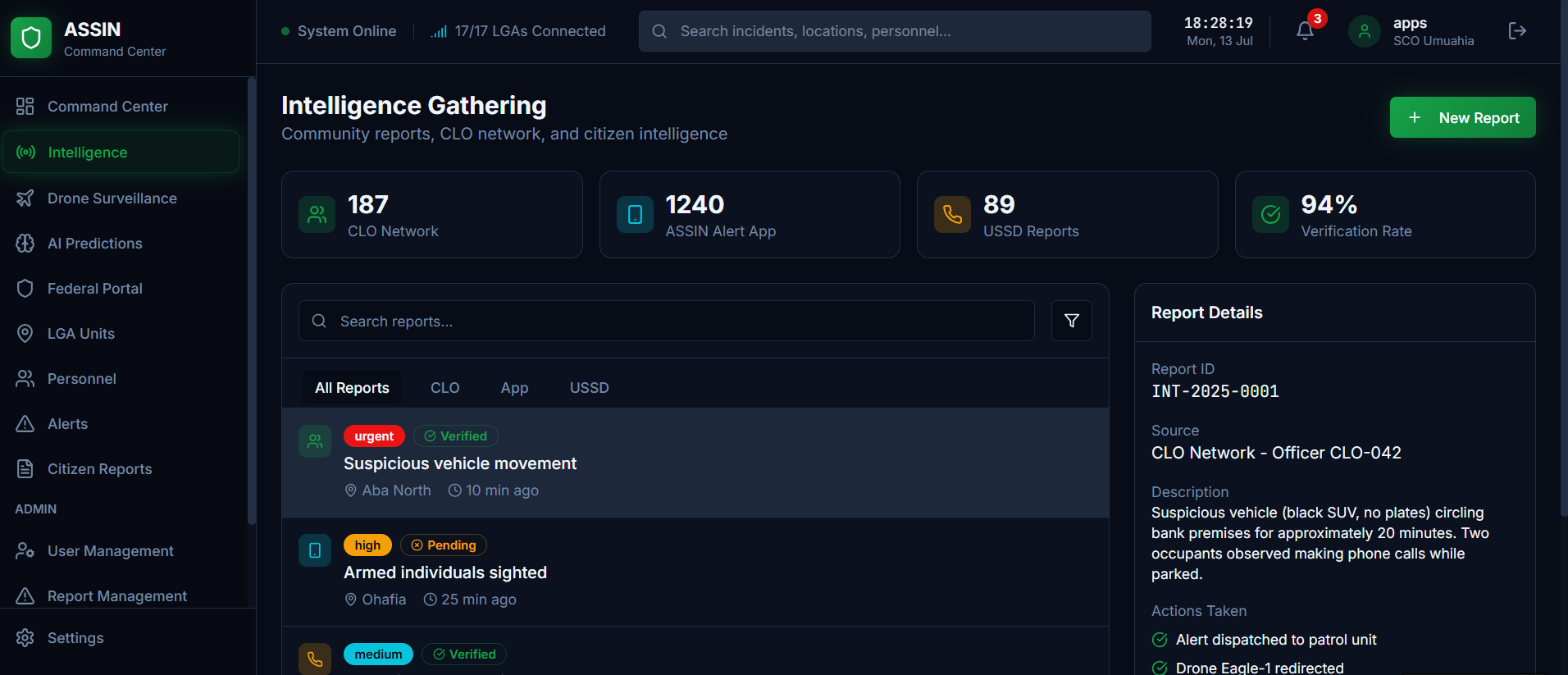
A multi-tenant command centre for state security, where each state or agency runs its own secure workspace. Every report lands in one place: citizen app and USSD tips, field officer reports, drone detections, gunshot sensors, panic buttons and AI risk forecasts. Today these signals sit in separate channels where reports are lost and no one can say who responded or how fast. SentinelEdge turns each one into a tracked case, routed to the nearest unit and followed from first alert to closure.

Intended users

State security directorates: command centre teams, field officers and federal agency liaisons.

Core capabilities

  • Unified case management with owners, deadlines and a full audit trail
  • Drone and AI-assisted dispatch to the nearest unit
  • Secure escalation to federal agencies with verifiable evidence

Request a demonstration

SentinelEdge command centre: the Intelligence Gathering screen with report counts and a list of community reports

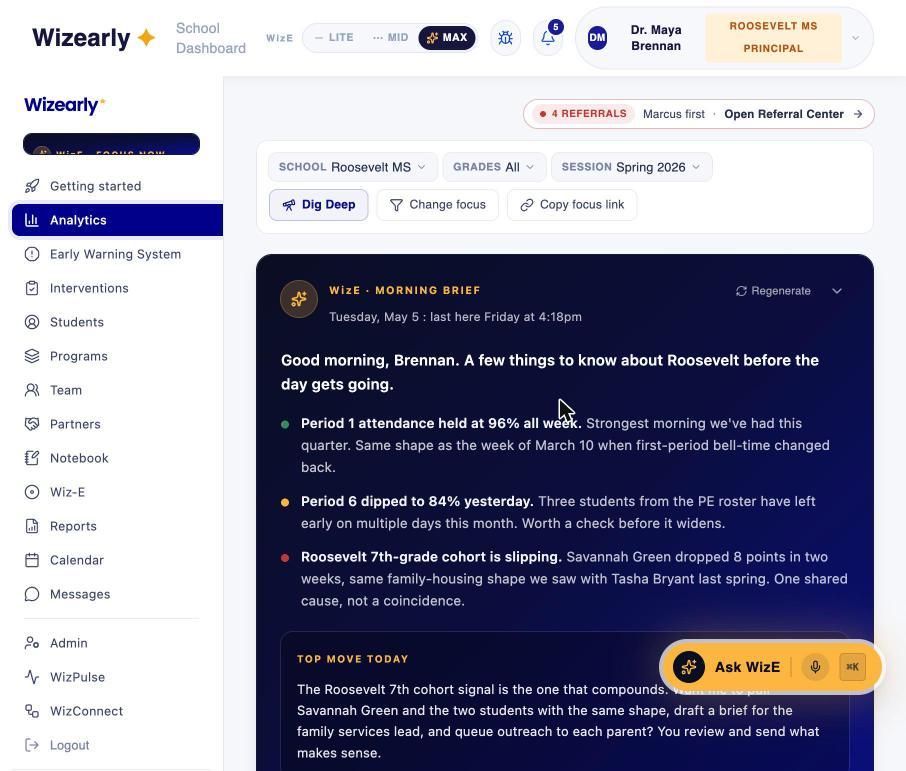
Wizearly school dashboard in a demo environment: the WizE Morning Brief with daily attendance signals and the Top Move Today
Demo environment. Names and figures are illustrative.
In development

Wizearly

Wizearly is being built to bring attendance, care notes, interventions and family outreach into one place. Its AI assistant, WizE, is designed to read that data every day and give each person a plain-language brief and one recommended next step, so at-risk students can be flagged while they are slipping, not after they become chronically absent.

Intended users

Schools, districts and community partners: principals, counselors, teachers, family liaisons and superintendents.

Core capabilities

  • A daily Morning Brief with one recommended Top Move
  • Early warning risk scores that flag how fast a student is slipping
  • Auto-drafted reports and outreach, sent only after an admin approves

This platform is under active development. We can walk through the architecture and current state, but it is not yet available for production deployment.

Ask about early access

Our approach

How an engagement actually runs.

Six stages, run iteratively rather than as a waterfall. Discovery recurs — what we learn in integration routinely changes the design.

Discover

Understand the operational context, the decision being made today, and who is accountable for it. Audit the data that actually exists, not the data an org chart implies.

Design

Solution architecture, data model and interface design. Agree what success is measured against before anything is built.

Engineer

Iterative delivery in working increments, with automated testing and evaluation running from the first sprint.

Integrate

Connect to systems of record and existing workflows. Usually the stage that surfaces the real constraints.

Deploy

Staged rollout with monitoring, access control, runbooks and a rollback path. Training for the people who will run it.

Optimise

Measure against the agreed baseline, retrain and tune where warranted, and retire what is not earning its place.

Why Egancin

What you are actually buying.

No rankings, no awards, no borrowed credibility. These are the characteristics you can test in a technical conversation before you commit to anything.

  • Cross-sector engineering. The same team has built scoring engines, operational analytics and multi-tenant platforms across transport, aviation, education and health. Patterns transfer; a maintenance-risk model and an attendance-risk model are closer than they look.
  • Problem-first, not model-first. We will tell you when a rules engine, a cleaner data pipeline or a better interface beats a model — and that answer is common.
  • Products as well as projects. We build platforms we operate ourselves, which means the engineering is informed by having to support it afterwards.
  • Integration as a first-class concern. Systems of record, authentication, data exchange. The work that decides whether a pilot becomes production.
  • Security-conscious engineering. Access control, encryption, audit trails and tenancy isolation designed at the architecture stage.
  • Research-led, honestly labelled. We run applied research and prototypes, and we mark them as such. A proof of concept is never presented as a product.
  • Accountable automation. Automated assessments support a named human decision-maker. They do not replace one, and our interfaces are built on that assumption.

Research & innovation

We build things that have not been built before.

Not every problem a client brings has an established answer. When it does not, the honest response is a structured investigation with a decision point at the end — not a fixed-price build on an unproven assumption.

Our research work runs as time-boxed feasibility studies and prototypes with explicit success criteria: can this signal be extracted reliably from the available data, at acceptable cost, with enough accuracy to change a decision? Sometimes the finding is that it cannot — which is a result worth paying for, delivered before a budget is committed to building it.

Current focus areas

  • Applied machine learning for operational risk scoring
  • Computer vision for condition assessment and inspection support
  • Language models applied to document-heavy professional workflows
  • Multi-agent architectures for analysis that requires several specialised steps
  • Evaluation methodology — how to know a model is actually working in production
  • Simulation and digital twins for operational planning

Research focus areas describe where we are investing engineering attention. They are not claims of published results or commercial availability.

Insights

Notes from the build.

All insights

These three cards are layout examples, not published articles. Thumbnails are placeholders.

Next step

Let's build what comes next.

Have a complex challenge, an ambitious idea, or a technology initiative that needs the right expertise? Tell us the operational problem and we will tell you honestly whether we are the right team for it.

Preview